
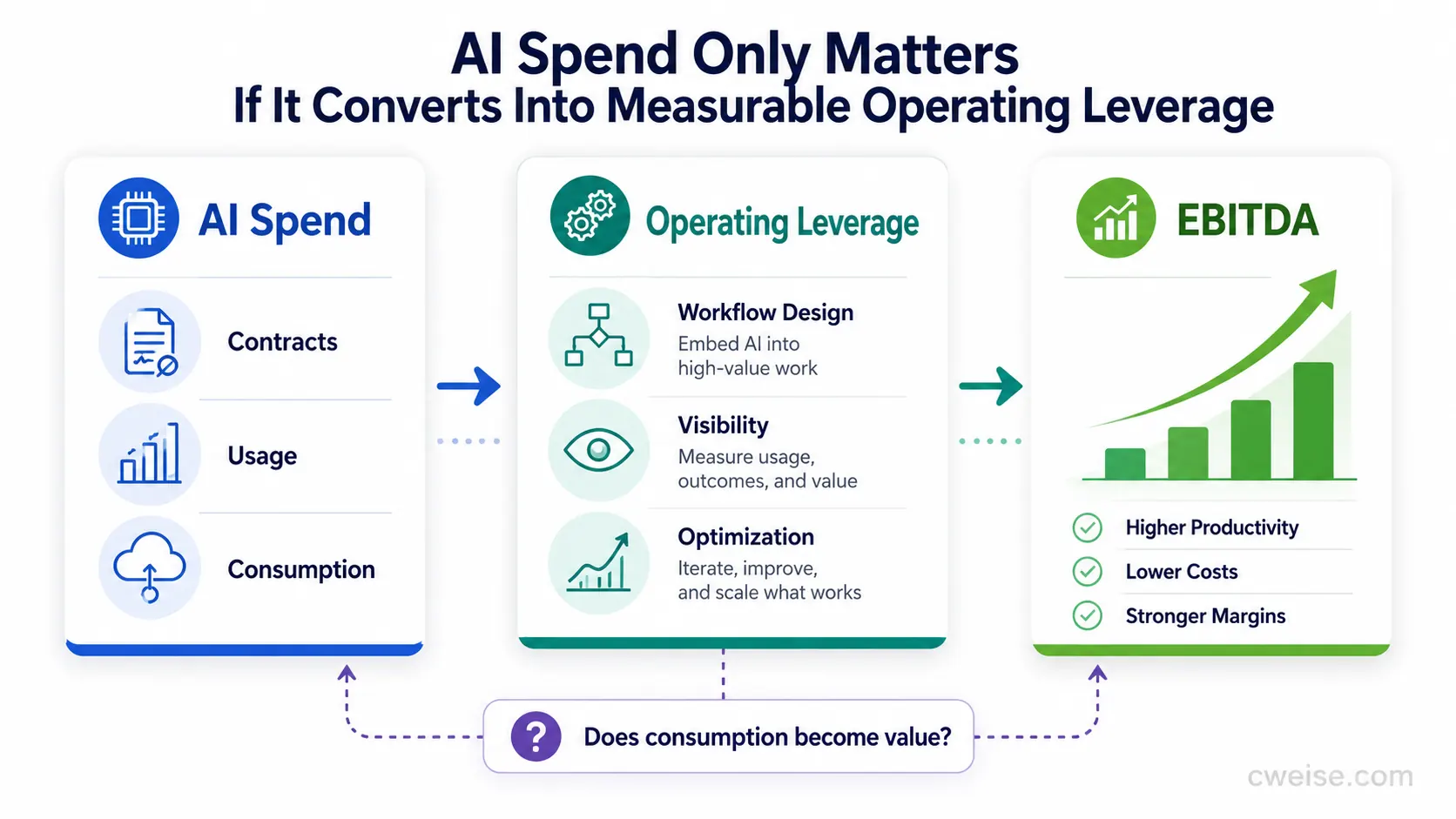
AI contracts are not the controversy
The contract is not the controversy. The question is whether consumption becomes operating leverage.
The real question is operating leverage
The board-level question is not whether people are using AI. It is whether AI usage is changing the economics of the work.
AI usage will expand beyond the obvious users
The newest token consumers may be the people whose work already carries the highest business context.
Consumption matters when it scales faster than value
AI cost is not the problem. Unmeasured consumption without value conversion is the problem.
The first management requirement is visibility
Visibility is not restriction. Visibility is the first condition for responsible scale.
The AI Consumption Leverage Calculator
Executive surface inputs
- Provider and model
- Employee count and AI user count
- Hours of use per day and workdays per month
- Average task complexity
- Execution path: hosted, local, or hybrid
Drill-down variables
- Input and output token shape
- Turns per session, prompts per hour, and retry rate
- Documents attached, average document size, and connector usage
- Context reuse, tool calls, and workflow path depth
- Local hardware, setup labor, maintenance labor, depreciation, and utilization assumptions
Decision outputs
- Monthly and annual hosted cost
- Monthly and annual local cost
- Hybrid cost range
- Cost per employee, AI user, and usage hour
- 2x, 5x, and 10x adoption scenarios with an estimated leverage range
The calculator is not trying to prove AI is expensive. It is trying to make the economics of usage discussable.
Seven ways to improve consumption without degrading the user experience
1. Prompt and instruction reuse
Reusable prompts, shared instructions, role templates, and task patterns reduce repeated prompt construction and inconsistent results. This is usually one of the easiest places to start because it improves user experience while reducing avoidable retries.
2. Context management
Context is one of the most important consumption drivers. Sending entire documents, long threads, large repositories, or repeated background material into every request can become expensive quickly. Better summaries, retrieval scopes, context packages, and document boundaries can preserve usefulness while reducing bloat.
3. Model routing
Not every task deserves the most capable model. Simple classification, formatting, first-pass summarization, or extraction may not require premium reasoning. At the same time, complex synthesis should not be underpowered. Routing is the discipline of matching the work to the model instead of letting every task take the same path.
4. Workflow design
AI should not be inserted into every workflow simply because it can be. Some tasks are better handled by templates, rules, deterministic automation, reporting tools, or well-designed forms. Workflow design asks where AI creates leverage and where it creates unnecessary consumption.
5. Caching and memory layers
Organizations should avoid paying repeatedly for the same summaries, classifications, lookups, reference interpretations, and context preparation. Caching and memory layers can preserve reusable work so the system does not keep reconstructing the same answer from scratch.
6. Local and hybrid execution
Local execution can be useful for certain low-risk, repetitive, or privacy-sensitive tasks, but it carries its own costs: hardware, tax, setup labor, maintenance, depreciation, support, power, and utilization risk. Hosted execution can offer stronger capability and lower operational burden, but usage can scale quickly. Hybrid design should compare paths without ideology.
7. Planning and budgeting
Planning and budgeting turn AI consumption from an invoice surprise into a managed operating assumption. Forecast ranges, department budgets, thresholds, approval triggers, monthly reviews, and scenario planning help management understand what happens when adoption doubles, quintuples, or becomes embedded across the enterprise.
The first savings may come not from using AI less, but from helping people use it with less waste.
What the board should expect from management
The board does not need token math. It needs assurance that management can convert AI usage into enterprise value.
The management standard
AI spend is rising. The better question is whether the operating model is turning that spend into EBITDA.
References
Menlo Ventures (n.d.). 2025: The State of Generative AI in the Enterprise. Menlo Ventures. menlovc.com/perspective/2025-the-state-of-generative-ai-in-the-enterprise/
Market estimate that enterprise AI spend reached $37B in 2025.
Stanford HAI (n.d.). The 2025 AI Index Report. Stanford HAI. hai.stanford.edu/ai-index/2025-ai-index-report
Reports organizational AI use rose to 78% in 2024 from 55% the year before.
McKinsey & Company (n.d.). The State of AI: Global Survey 2025. McKinsey & Company. www.mckinsey.com/capabilities/quantumblack/our-insights/the-state-of-ai
Describes workflow redesign and management practices as key factors in capturing AI value.