cweise.com

Writing

The Friday Night Cap

June 20, 202610 min read

A story-driven Operations Executive essay on why AI-supported delivery needs real-time consumption visibility before caps, quotas, and provider limits become missed commitments.

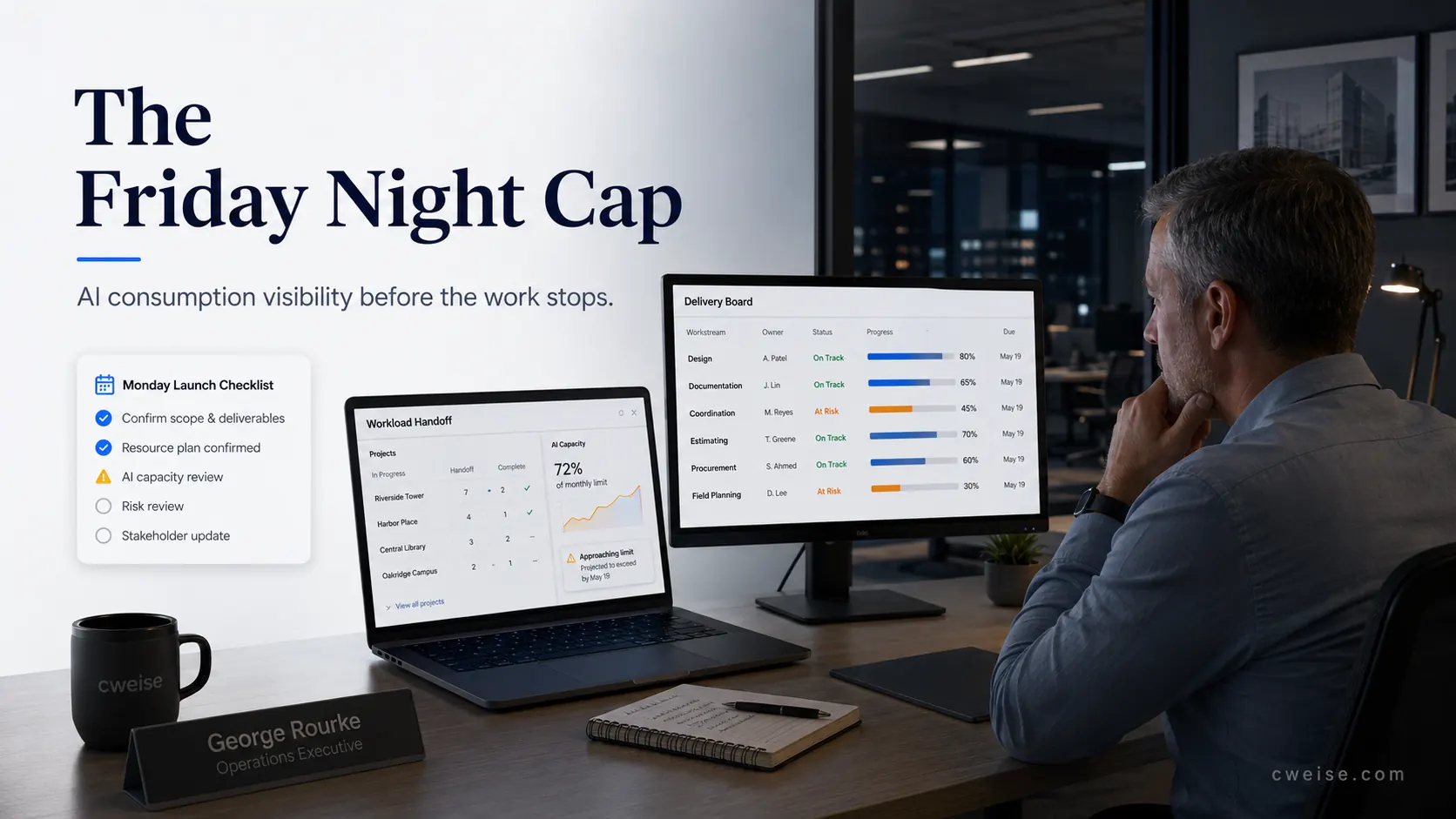
The Friday Night Cap

At 6:43 on a Friday evening, George Rourke was still at his desk.

Most of the office had already emptied out. The project managers had stopped replying. The discipline leads were gone. A few Teams notifications still drifted in, but the tone had changed. Less decision-making. More weekend logistics.

George stayed because Monday mattered.

For the last six months, he had been watching a small internal development team move faster than it had any right to move.

Not recklessly. Not magically. Just faster.

Backlog items that used to sit for a week were coming back in two days. Prototype screens were becoming working interfaces before the next steering meeting. Data cleanup that usually got pushed behind “real work” was suddenly getting done.

The team was still dealing with the normal mess: old business rules, awkward dependencies, partially documented workflows, and users who remembered exceptions no one had written down.

But something had changed. George could see it in the cadence. The team was generating at a new level.

He knew AI had something to do with it. The developers were using it to summarize code paths, generate test scenarios, explain old logic, draft migration notes, and turn rough operating requirements into cleaner technical tasks.

That did not bother him. That was the point.

For years, operations leaders had been told that technology teams needed more time, more people, more translation, and more patience. Now this small team was finally compressing the distance between an operating idea and a working solution.

George did not need to understand every prompt. He needed the delivery engine to keep working.

The delivery dependency no one was measuring

The project on his mind that Friday was not glamorous. It was a workload handoff dashboard. The kind of tool most executives do not get excited about until it does not exist.

Its job was simple: show what happened when work moved from one group to another.

Civil waiting on survey. Permitting waiting on missing context. Project managers waiting on discipline reviews. Regional teams absorbing cleanup work that never appeared in the original plan.

Every department had a version of the truth. Every post-project review found the drag too late. George wanted the argument to stop being anecdotal.

The prototype had done enough to prove the idea. Now the team was moving it into something the organization could actually use.

That meant cleaning up the data model. One relationship table had become the problem.

It had started as a prototype shortcut, the kind of table that makes sense when three people are trying to prove a concept and no one knows whether the thing will survive the month. It linked projects, departments, handoff events, reviewers, delay reasons, and follow-up actions just well enough to make the demo work.

But prototypes tell the truth late. The relationship table was carrying too much meaning. If the dashboard was going to be trusted beyond the pilot group, the table had to be refactored.

By Friday afternoon, the work was nearly done. The team had mapped the relationships, cleaned up the migration path, generated test cases, and reviewed the affected queries. The schema migration was in its last validation pass. Codex had been helping the team compress the project context one more time so the remaining changes could be checked against the full chain of assumptions.

Not a rewrite. Not a science project. A final controlled push from prototype to usable internal product.

At 6:47, the lead developer posted the update George wanted to see: “Relationship refactor is through migration testing. Final context compression running now. If validation passes, we can package the release notes and promote the build.”

George read it twice. That sounded like Monday was safe.

At 6:52, another message came through: “Codex is slowing down. We may be near the cap.”

George looked at the message for a few seconds. The cap.

He understood the general idea. The team had AI capacity limits. There were budgets, tokens, quotas, model limits, and approval thresholds somewhere in the background.

Somewhere in the background was the problem.

The team had been using AI as part of the delivery system. Not as a toy. Not as a shortcut around engineering judgment. As a practical layer for understanding old code, compressing context, generating test coverage, checking migration assumptions, and keeping a small team moving at a pace the business had started to trust.

At 6:58, the next message landed. “Requests blocked.” Then another. “Need approval to extend capacity or switch allocation.”

Then the channel went quiet in the worst possible way. People were still working. But the decision they needed had left the building.

The migration was almost complete. The prototype was almost ready. The relationship refactor was almost through. Codex needed to compress the context one more time.

That is when the cap hit.

The work did not stop because the team lacked skill. It did not stop because the requirement was unclear. It did not stop because the prototype failed.

It stopped because AI capacity had become part of the delivery chain, and no one had instrumented it like a delivery dependency.

By Monday morning, the issue would not sound technical. It would sound like a miss.

The dashboard George had told the organization to expect would not be ready. The small team that had been moving at a new pace would look unreliable. The internal communications note would still be live. Managers would ask what happened. Technology would explain capacity. Finance would ask whether the usage had been planned. Operations would absorb the credibility hit.

That is the problem this article is about. AI consumption is no longer just a vendor bill, a developer preference, or a background limit.

When AI becomes part of how work gets delivered, AI capacity becomes an operating dependency. And operating dependencies need meters before they become missed commitments.

The work was almost complete. The dependency no one had measured was the AI capacity behind the final push.
When AI becomes part of how work gets delivered, AI capacity becomes an operating dependency.

What the cap actually means

An AI cap is the point where normal use becomes exception handling.

The cap may be a monthly budget, a token pool, a model quota, a rate limit, or an approval threshold. The form changes by provider, contract, and operating model.

The effect is the same. At some point, the system says: “You can continue only if something changes.”

Someone approves more capacity. The work moves to another model. The team reduces scope. Or the request is blocked.

Caps are not wrong. Organizations need limits around cost, capacity, risk, and vendor exposure.

The problem is not that a boundary exists. The problem is when the boundary becomes visible only after someone runs into it.

That is what happened to George’s team. The development team experienced a blocked workflow. Leadership experienced a surprise. The organization experienced a credibility problem.

A cap without telemetry is not a control system. It is a locked door at the end of a dark hallway.

A cap without telemetry is not a control system. It is a locked door at the end of a dark hallway.

The failure was not the limit

The provider limit was not the real failure.

Limits are normal. Budgets have limits. Cloud environments have limits. Vendor contracts have limits. Approval authority has limits.

The operating failure was that no one could see the limit approaching while there was still time to respond.

A useful AI consumption meter would have changed the situation before it became a public miss.

It could have shown the project was consuming capacity faster than expected. It could have connected the usage pattern to a Monday delivery commitment. It could have triggered escalation before the approval window closed.

That is the difference between a cap and a meter.

A cap stops the work. A meter shows the work is heading toward the stop.

This is where AI governance becomes operational.

The question is not only whether the organization has limits. The better question is whether the people responsible for delivery can see those limits early enough to make a better decision.

A cap stops the work. A meter shows the work is heading toward the stop.
The operating failure was that no one could see the limit approaching while there was still time to respond.

AI consumption is not seat count

A seat count tells the organization who has access. It does not explain what the work is consuming.

One user asks for a short rewrite. Another pastes a 40-page report and asks for structured analysis. A development team uses AI to reason through migration notes, test cases, and release documentation.

All three uses may be legitimate. They do not have the same consumption shape.

The cost is shaped by context size, model selection, reasoning depth, repeated attempts, output format, and workflow design.

That is why a monthly invoice arrives too late.

It tells the organization what was consumed after the behavior already happened. It does not tell George that his launch team is about to lose capacity. It does not tell the developer that one more context compression is going to push the project past a threshold.

It does not tell the Operations Executive whether the consumption reflects useful acceleration, duplicated effort, poor workflow design, or unmanaged demand.

If AI is becoming part of how work gets done, then AI consumption has to become visible inside the work itself.

Access is binary. Consumption has shape.

The meter belongs at the moment of use

Most AI consumption data shows up too late: vendor dashboards, admin consoles, billing reports, and monthly reviews.

Those views matter, but they are downstream. They explain what happened after the operating moment has passed.

The useful moment is earlier: before the request is submitted, before the workflow burns through the remaining pool, and before the Friday night cap becomes a Monday morning explanation.

At that moment, the user does not need a finance report. They need operating feedback.

Something simple: “This request is larger than usual for this workstream.” “You are at 72% of the session threshold.” “This model may be more than the task requires.”

That is not punishment. That is useful feedback.

A developer should not have to guess whether one more context compression is about to trip an invisible wire. A manager should not learn from a missed commitment that the team was out of capacity. Operations should not have to translate a technical limit into an organizational apology.

The point of the meter is to move the signal earlier.

The point of the meter is to move the signal earlier.

Pre-flight estimates are enough to start

The first version of the meter does not need perfect precision.

Before a request is submitted, the system can estimate the likely consumption profile. It can look at prompt length, pasted context, task type, requested output, selected model, reasoning level, workstream tag, and remaining allocation.

That estimate will not be exact. It does not need to be exact. It needs to be useful enough to change behavior before execution.

A pre-flight estimate can tell the user: “This looks like a high-consumption request.” “This workstream has limited remaining capacity.” “This task should be split into two steps.”

If the request is executed through a governed interface, the system can later reconcile the estimate against actual provider usage.

That creates a simple operating loop. Estimate before execution. Measure after execution. Improve the workflow over time.

This matters because many organizations do not need to start with a fully mature AI control plane. They can start with a thin telemetry layer.

The first useful surface is not a perfect cost system. It is feedback at the moment of use.
Estimate before execution. Measure after execution. Improve the workflow over time.

The telemetry layer should be thin

The answer is not to build a giant AI bureaucracy. The answer is to make approved AI usage observable enough to manage.

A thin telemetry layer can sit between users and AI-enabled work. It can be part of an internal application, a workflow tool, a local development environment, a Python seam, an API gateway, a VS Code extension, or a controlled execution layer.

The implementation can vary. The operating purpose is the same: capture the signal before the organization loses the plot.

A useful telemetry event might include the user, team, workstream, model, request type, estimated tokens, actual usage when available, estimated cost, remaining cap, warning state, and recommended action.

That event is where governance starts to become real. Not in the policy deck. Not in the invoice. In the event.

Because once the event exists, the organization can aggregate it, trend it, forecast from it, coach against it, and decide what should happen next.

The telemetry layer does not have to store every prompt, inspect every sentence, or slow every request. It needs to capture the minimum useful signals that explain what the work is consuming and what should happen next.

Capture the signal before the organization loses the plot.

Why this matters to Operations Executives

Operations Executives live with the consequences of missed handoffs.

A technical limit becomes a delivery problem. A delivery problem becomes a communication problem. A communication problem becomes a trust problem.

In George’s case, each group saw the same event differently. The development team saw a capacity issue. Technology saw a provider constraint. Finance saw consumption risk. Communications saw a credibility issue. Managers saw confusion. Users saw a broken promise.

Telemetry creates the shared view. It gives the organization a way to see the operating pattern before every group invents its own explanation.

In the launch scenario, the meter may not have guaranteed the dashboard shipped Monday. But it would have changed the conversation before Monday.

The team could have reduced context size. The work could have been routed differently. A temporary capacity request could have been approved before Friday evening.

The organization might still have made a hard decision. But it would not have discovered the decision after the work stopped.

That is the point. AI consumption telemetry does not make governance theoretical. It makes governance operational.

Telemetry creates the shared view before every group invents its own explanation.

The meter also supports velocity decisions

The goal is not to spend less on AI every time. That is too simplistic.

Some AI-supported work deserves more capacity. Some should be routed to a different model. Some should be coached, reviewed, or stopped.

Telemetry helps the organization tell the difference.

Without telemetry, velocity decisions become political. The most visible project gets the exception. The loudest team gets more capacity. The team with the best story gets the budget.

With telemetry, the organization can ask better questions.

Which workstreams are consuming the most AI capacity? Which requests are tied to delivery commitments? Which repeated patterns suggest caching, templates, or workflow redesign?

This is where consumption telemetry becomes more than cost control. It becomes a way to connect AI usage to operating velocity.

The mature question is not: “How do we stop AI spend?”

The mature question is: “Which AI consumption is becoming operating leverage, and which AI consumption is just becoming cost?”

A meter gives the organization a way to ask that question with evidence.

The mature question is which AI consumption is becoming operating leverage, and which AI consumption is just becoming cost.

What to build first

The first version does not need to be complicated.

Start with an approved interface or simulator. Capture estimated prompt size, selected vendor, selected model, reasoning level, workstream, warning state, and session consumption.

Show the user what is happening before the request is submitted.

Then add actual usage reconciliation where the organization controls the execution path. Then add team and workstream views. Then add thresholds, recommendations, and approval flows.

The maturity path is straightforward: estimate, measure, attribute, forecast, govern, optimize.

This is not a call to overbuild. It is a call to start measuring the part of AI adoption that will otherwise become invisible until it becomes expensive, disruptive, or embarrassing.

Implementation sequence

  • Estimate: give users pre-flight feedback before execution.
  • Measure: capture actual usage when requests flow through approved systems.
  • Attribute: tie consumption to user, team, role, model, and workstream.
  • Forecast: show burn rate, remaining capacity, and projected cap exhaustion.
  • Govern: use thresholds, routing, review, budget rules, and escalation workflows.
  • Optimize: use the data to improve prompts, context design, model routing, caching, workflow design, and velocity prioritization.
Start measuring the part of AI adoption that will otherwise become invisible until it becomes expensive, disruptive, or embarrassing.

The management standard

The goal is not less AI. The goal is less unmanaged AI.

A firm can spend more on AI and still be making the right decision if that consumption is tied to faster delivery, lower rework, better decisions, stronger throughput, or more scalable expertise.

But management cannot prove that with enthusiasm. It needs telemetry.

A meter creates the shared operating language. Users see where they stand. Managers see which behaviors need coaching. Finance sees burn before surprise. Technology sees where routing and defaults need improvement. Operations sees whether AI is becoming leverage or noise.

The Friday night cap is not really a story about a development team getting blocked. It is a story about what happens when AI-supported work becomes a delivery dependency before AI consumption becomes an operating signal.

That gap is manageable. But it has to be seen.

A cap tells the organization where the boundary is. A meter tells the organization what is happening before the boundary is reached.

In enterprise AI, that difference will decide whether governance feels like a useful operating system or a surprise locked door at 7:00 on a Friday night.

The goal is not less AI. The goal is less unmanaged AI.
A cap tells the organization where the boundary is. A meter tells the organization what is happening before the boundary is reached.