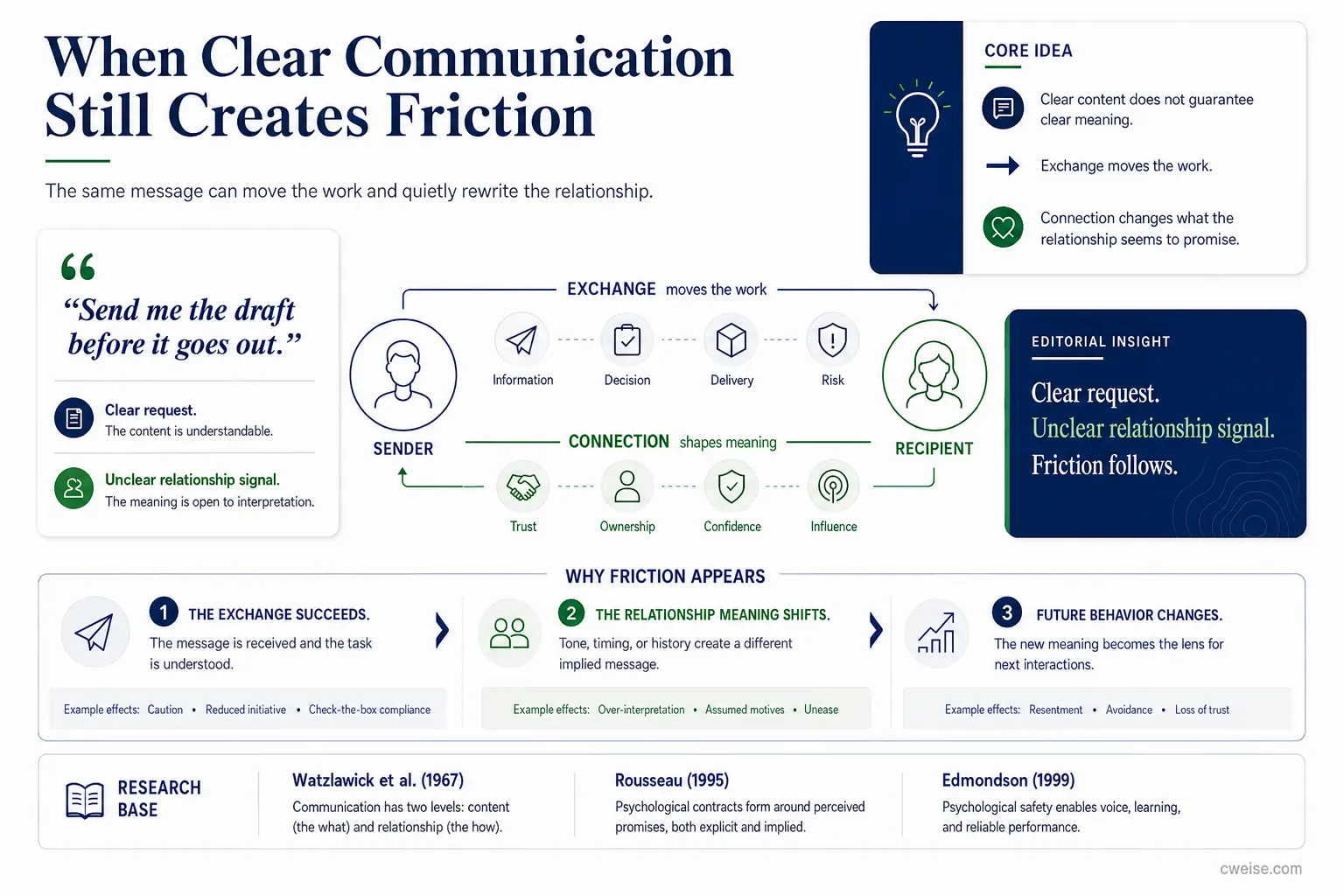
A practical framework for treating exchange and connection as independent variables, clarifying the meaning carried by workplace communication, protecting employee agency, and improving the efficiency of long-term working relationships.
A message can be perfectly clear and still make the next interaction harder.
“Send me the draft before it goes out.”
Nothing is inherently wrong with the request. The work may move faster, risk may decrease, and the final product may improve. Yet the sentence does something else at the same time. Depending on the relationship, it may communicate support, necessary oversight, or a loss of confidence in the employee’s judgment.
The sender may believe a document was requested. The recipient may leave with a new understanding of the relationship. Both interpretations can be reasonable.
The Exchange + Connection Framework separates those two effects. Exchange describes what the interaction must move: information, a decision, an action, a commitment, or a deliverable. Connection describes the human meaning the interaction creates: trust, respect, belonging, support, distance, or obligation. Treating them as independent variables makes it easier to preserve efficiency without asking people to ignore the relationship signals embedded in the work.
This distinction is especially useful for employees who take language seriously. A direct request does not have to feel automatically hostile. Warmth does not have to be mistaken for influence, sponsorship, or friendship. A manager can protect ownership with one additional sentence. An organization can clarify what words such as voice, access, safety, and care actually promise.
The goal is not to communicate more. It is to reduce the amount of meaning people are forced to invent.
Every interaction carries two variables
Most communication advice focuses on the content of a message: whether the objective is clear, the request is specific, the channel is appropriate, and the next step is understood. Those disciplines matter because exchange is how work moves. Information changes hands. Decisions are made. Responsibility becomes visible. A deliverable advances.
Communication also carries relationship information. Paul Watzlawick, Janet Beavin, and Don Jackson argued that messages operate simultaneously at a content level and a relationship level. The words communicate the task, while tone, context, history, and role help define how the words should be interpreted and what they imply about the people involved (Watzlawick, Beavin, & Jackson, 1967) .
The Exchange + Connection Framework translates that distinction into two independent variables. Exchange asks, “What needs to move because this interaction occurred?” Connection asks, “What will this interaction lead the participants to believe about one another afterward?”
They are not opposites. A highly transactional interaction can be respectful and humane. A deeply connected relationship can still require a direct decision. Some exchanges should consume approximately the emotional energy required to use a reliable machine. Others carry more human weight because the relationship itself has value beyond the immediate task.
The objective is not to maximize either variable. It is to find the combination that fits the work, the moment, the power relationship, and the history between the stakeholders.
Exchange and connection are independent variables. The best combination depends on the work and the relationship.
Healthy communication is not more exchange or more connection. It is the right amount of each.
“It is only business” is often a late clarification
The sentence “Do not take it personally” is usually offered as a boundary. It often arrives after the boundary would have been useful.
A leader may encourage candor, describe the team as safe, offer unusual access, express personal investment, or frame the relationship as a partnership. The employee responds to those signals by sharing more information, taking greater interpersonal risk, contributing discretionary effort, or treating the leader’s success as personally important.
Later, the employee discovers that the relationship was narrower than the signal suggested. Access did not create influence. Candor was welcome only while it supported the leader’s preferred direction. Personal concern did not extend to sponsorship, repair, or reciprocal risk. At that point, “it is only business” does not merely clarify a boundary. It transfers the cost of the earlier ambiguity to the person who invested in the apparent connection.
This does not require deliberate manipulation. Psychological contracts are beliefs about reciprocal obligations that develop beyond the written employment agreement through promises, patterns, and interpretation (Rousseau, 1989) . A perceived violation can emerge when one party believes a promise existed and the other party never understood that the promise had formed (Morrison & Robinson, 1997) .
The more useful question is therefore not whether the employee should have taken the interaction personally. It is whether the leader, manager, or organization used connection signals that reasonably invited personal meaning without clarifying the limit of the commitment.
The costly gap appears when the boundary is revealed only after the other party has invested in the relationship signal.
A boundary stated after relational investment is not neutral clarification. It may be the moment the cost of ambiguity becomes visible.
Intensity changes the outcome
Exchange and connection can each be too weak, appropriately intense, or stronger than the situation can support. The important point is that the same intensity is not healthy in every interaction.
Exchange becomes excessive when oversight, reporting, review, or urgency exceeds the risk the work actually carries. Each request may be defensible in isolation, yet the cumulative signal teaches employees that ownership is temporary and judgment remains centralized. People respond by documenting more, deciding less, and waiting for approval. Leadership then sees reduced initiative and adds more control.
Connection becomes excessive when the relationship is asked to carry more emotional responsibility than the work requires. A manager may feel obligated to eliminate every employee’s discomfort before giving direct feedback. An employee may treat a routine disagreement as evidence of personal rejection. A team may process every tension until maintaining the relationship begins replacing the work.
Too little exchange and too little connection create drift. The meeting produces neither a decision nor meaningful understanding. High exchange and high connection can also be poorly fitted. A crisis, performance correction, or client escalation may become overloaded when every operational decision must also carry reassurance, personal validation, and relational repair.
Right-sized communication does not sit permanently in the middle of a chart. It is the point at which the exchange is strong enough to move the work and the connection is accurate enough to preserve the human conditions the relationship genuinely supports.
The right fit is situational. A communication style that builds trust in one relationship can create control, blur, or false expectations in another.
Power changes the cost of ambiguity
An unclear connection signal does not cost every stakeholder equally. The person who controls access, assignments, performance judgments, sponsorship, compensation, or future opportunity can usually redefine the relationship with less personal risk.
Power-dependence theory explains that power increases when one party depends more heavily on resources controlled by the other (Emerson, 1962) . In a workplace relationship, the manager or executive may control decisions that matter materially to the employee, while the employee’s primary leverage is effort, expertise, information, and cooperation.
That asymmetry makes relational ambiguity exploitable, even when exploitation was not the original intent. Warmth and access can produce better information. Psychological safety language can encourage candor. Mentorship language can elicit loyalty and discretionary effort. If the power holder later rejects the influence, reciprocity, or protection the employee reasonably associated with those signals, the organization retains the value while the employee absorbs the disappointment.
The employee may then become more guarded. Initiative narrows. Candor becomes selective. More communication is routed through documentation rather than trust. Those behaviors can look like reduced capability or commitment from above, even though they may be protection responses to an ambiguous or violated relationship.
This is not an argument that resentment proves the employee was right, or that every disappointed employee was exploited. It is an argument for better diagnosis. Before labeling the person, examine whether the system encouraged investment in a connection it was never prepared to honor.
Power makes unclear connection expensive because the party with less control usually bears more of the cost when meaning changes.
Sometimes the employee did not lose capability. The employee lost faith in what the relationship appeared to promise.
The organization creates the interpretive platform
The solution cannot depend on every employee accurately decoding every leader or every manager developing exceptional emotional awareness. Every interaction occurs inside an organizational platform that has already taught people what certain words and behaviors are likely to mean.
When the organization says employees have a voice, does that mean they may speak, receive a response, influence a decision, or make it? When a leader offers access, is the offer for escalation, coaching, sponsorship, or personal connection? When a team promises safety, does it mean protection from humiliation, permission to disagree, emotional comfort, or freedom from consequences?
Amy Edmondson’s research defines psychological safety around the interpersonal consequences of taking relevant risks, such as asking for help, reporting a mistake, or challenging an assumption. It is not the same as coziness, friendship, or guaranteed agreement (Edmondson, 1999) . A credible promise is therefore specific: people may contribute candidly without humiliation or retaliation, while authority and accountability remain intact.
The organization establishes credible defaults. Leaders avoid signaling more connection than they can honor. Managers translate authority into the interaction by naming the reason for the request, the boundary of the decision, and the ownership that remains with the employee. Employees and clients should not have to infer the entire relationship contract from warmth, access, silence, or a single reversal.
The platform-level objective is not to eliminate interpretation. It is to reduce the amount of motive people must invent.
Organizations reduce ambiguity by defining credible defaults and making authority, access, safety, and repair easier to interpret.
Individuals should not need exceptional emotional intelligence to understand what the organization is offering.
A practical method for right-sizing the interaction
The framework can be applied through four decisions. The decisions are simple enough to use before a consequential email, meeting, feedback conversation, escalation, or request for help.
First, define the exchange. What must move because this interaction occurred? Is the required output information, a decision, an action, a correction, a commitment, or a completed deliverable? This prevents relational language from obscuring the actual work.
Second, examine the connection. What meaning could reasonably form from the tone, timing, access, language, history, and power relationship? The question is not what the sender privately intends. It is what a reasonable stakeholder may infer from the complete pattern.
Third, test the fit. How much connection can this relationship honestly carry? Role, history, trust, power, stakes, and future dependence all matter. A long-term partnership can support forms of challenge and repair that would feel intrusive in a bounded professional exchange.
Fourth, clarify the signal. State enough context to align the request, the reason, and the remaining ownership. The goal is not a speech. One additional sentence is often sufficient.
The four-question filter
Exchange: What needs to move?
Connection: What meaning could this interaction create?
Fit: What can this relationship honestly carry?
Signal: What must be stated so the boundary and ownership remain clear?
The practical sequence is exchange, connection, fit, and signal.
Say enough to align the work and the relationship. Do not force the recipient to invent the boundary.
One request can create four different realities
Return to the original sentence: “Send me the draft before it goes out.” The organization may hear a reasonable quality-control step. The manager may mean that final client risk remains with the manager. The employee may interpret a loss of confidence in the employee’s judgment. The client may assume that the manager has personally validated every technical detail.
Nobody is necessarily lying. They are operating from different understandings of the exchange, the connection, and the ownership transferred by the review.
A small amount of context can align them: “Send me the draft before it goes out. I own the final client risk. You still own the technical recommendation, so flag anything you believe should not be changed.”
The additional language does not make the interaction warmer. It makes the boundaries more accurate. The manager retains accountability. The employee retains agency. The client receives appropriate review. The organization avoids creating an approval process that silently moves all judgment upward.
Self-determination theory distinguishes autonomous motivation, in which people act with a sense of willingness and ownership, from controlled motivation driven primarily by pressure. Workplace research connects support for autonomy and competence with stronger performance and well-being (Deci, Olafsen, & Ryan, 2017) . Clear ownership is therefore not merely a relational courtesy. It protects the quality of the exchange.
The added sentence does not soften accountability. It prevents accountability from silently consuming agency.
Clear boundaries maximize the transactional value
Managers who want efficient transactions have a practical reason to clarify connection. When employees know the limits of access, influence, support, and ownership, they spend less energy interpreting tone, protecting status, or constructing explanations for inconsistent behavior.
A bounded relationship can be highly effective. The manager does not have to provide friendship, emotional intimacy, or unlimited access. The employee does not have to care deeply about the manager as a person. Both parties can complete the work with professionalism, dignity, and little emotional residue.
The boundary becomes more important, not less important, when the leader chooses warm or relational language. Warmth is not proof of trust. Access is not influence. Listening is not agreement. Input is not ownership. Mentorship is not sponsorship unless the leader is willing to act like a sponsor when doing so carries cost.
This is also why connection should not be dismissed as inefficiency. Appropriate connection improves information flow, supports repair, makes challenge safer, and allows long-standing relationships to survive difficult transactions. Clark and Mills’ distinction between exchange and communal relationships helps explain why people use different rules to interpret reciprocity and care across relationships (Clark & Mills, 2012) . The managerial task is to avoid blending those rules carelessly.
Name the reason
“I need to review this because I carry the final client risk.”
Protect ownership
“The technical recommendation remains yours.”
Define participation
“I want your strongest challenge before I make the final decision.”
Limit the promise
“My door is open for escalation and context. Routine decisions should stay with you.”
Boundaries do not weaken connection. They keep connection from making promises the relationship cannot support.
Less villainizing, more usable information
When relationship meaning remains ambiguous, people fill the gap with motive. The manager becomes controlling. The employee becomes resistant. Leadership becomes dishonest. The client becomes unreasonable. Some of those judgments may eventually be accurate. They are still poor starting points for diagnosis.
Chris Argyris described defensive routines that allow capable professionals to protect themselves from embarrassment or threat while blocking the learning they claim to value (Argyris, 1991) . Ambiguous relationship signals can feed those routines. Managers add oversight because employees appear less dependable. Employees share less because managers appear controlling. Each side receives new evidence for the villain already constructed.
The Exchange + Connection Framework interrupts that cycle before character becomes the only available explanation. What work was the interaction supposed to move? What connection did the behavior reasonably imply? Was the intensity of either appropriate? What did the organizational environment teach each stakeholder to expect? Where did power make the cost of ambiguity unequal?
Those questions do not absolve anyone of responsibility. They make responsibility easier to assign accurately. They also protect the organization from reducing a relationship problem to an individual performance problem and then introducing controls that make the original friction worse.
When the structure does not explain the behavior, people explain the person.
The operating standard
Transaction and connection are not competing moral positions. They are variables that can be optimized together. Clear exchange improves speed, quality, accountability, and decision-making. Accurate connection supports trust, candor, repair, and relationships capable of carrying difficult work over time.
Not every interaction should feel personal. Not every transaction should feel cold. A healthy workplace does not require everyone to care deeply about everyone else. It requires enough humanity that people are not diminished by the exchange and enough clarity that warmth, access, and safety are not mistaken for commitments the powerful party can later deny.
The standard is not perfect communication. It is less unnecessary interpretation. The work moves. Ownership stays legible. The relationship carries only the meaning it can honestly support.
Efficiency and long-standing relationships are not the opposite ends of a spectrum. They are what becomes possible when exchange and connection are right-sized deliberately.
Move the work. Clarify the meaning. Protect the ownership. Let the relationship carry only what it can honestly support.
References
Watzlawick, P., Beavin, J. H., & Jackson, D. D. (1967). Pragmatics of Human Communication: A Study of Interactional Patterns, Pathologies, and Paradoxes. W. W. Norton & Company. wwnorton.com/books/9780393010091
Foundational distinction between the content and relationship levels of communication.
Distinguishes exchange relationships from relationships organized around responsiveness to another person's needs.
Rousseau, D. M. (1989). Psychological and Implied Contracts in Organizations. Employee Responsibilities and Rights Journal, 2(2), 121–139. DOI: 10.1007/BF01384942
Foundational account of beliefs about reciprocal obligations beyond the formal employment contract.
Morrison, E. W., & Robinson, S. L. (1997). When Employees Feel Betrayed: A Model of How Psychological Contract Violation Develops. Academy of Management Review, 22(1), 226–256. DOI: 10.5465/amr.1997.9707180265
Explains how perceived discrepancy and interpretation can develop into emotional contract violation.
Emerson, R. M. (1962). Power-Dependence Relations. American Sociological Review, 27(1), 31–41. DOI: 10.2307/2089716
Foundational theory connecting power to unequal dependence on valued resources.
Edmondson, A. C. (1999). Psychological Safety and Learning Behavior in Work Teams. Administrative Science Quarterly, 44(2), 350–383. DOI: 10.2307/2666999
Defines psychological safety as a shared belief about the interpersonal consequences of taking relevant risks.
Deci, E. L., Olafsen, A. H., & Ryan, R. M. (2017). Self-Determination Theory in Work Organizations: The State of a Science. Annual Review of Organizational Psychology and Organizational Behavior, 4, 19–43. DOI: 10.1146/annurev-orgpsych-032516-113108
Reviews autonomy, competence, relatedness, and the quality of motivation in work settings.